News cover image showing a Chinese food delivery rider under algorithmic and income pressure

A censored Sanlian Life Lab documentary has renewed attention on China’s food delivery riders, showing how low pay, platform algorithms, safety risks, and weak bargaining power shape daily work for millions of riders.

A documentary by Sanlian Life Lab has drawn renewed attention to the lives of China’s food delivery riders after it was removed from domestic platforms and preserved by archive sites overseas.
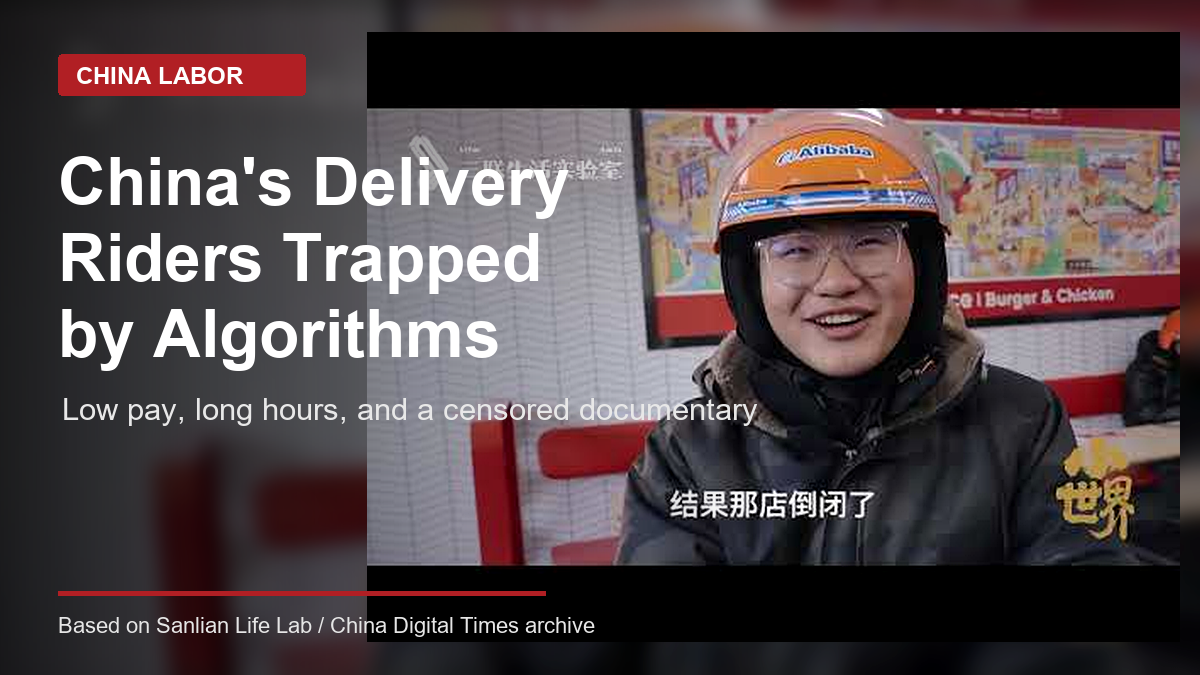
News cover image showing a Chinese food delivery rider under algorithmic and income pressure
News cover for the China food delivery rider documentary story.

The film, 2026 China Food Delivery Rider Survival Report, was first published on April 17, 2026, according to China Digital Times, which later archived the text and video. Other Chinese-language sites reported that the documentary was taken down within days. A YouTube backup remains available.

A Low-Paid Industry Under Algorithmic Pressure

The documentary focuses on riders in Beijing, including Yuxinzhuang village near the northern Sixth Ring Road, the CBD, and Wanliu. These places differ sharply in income level and social status, but riders describe similar pressures: more competition, lower delivery fees, long hours, and constant dependence on platform systems.

China Digital Times’ archive says the number of food delivery riders in China has exceeded 13 million. It also says delivery pay has fallen from more than 10 yuan per order in the industry’s early years to roughly 3 to 5 yuan today. Riders interviewed in the film describe fighting for orders in crowded markets where platform assignment rules decide who earns and who waits.

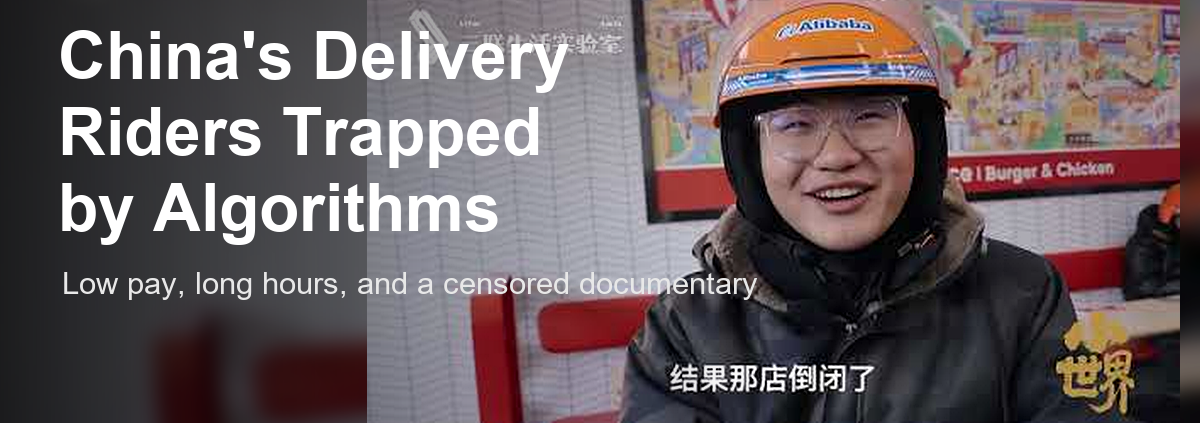
Video thumbnail for a censored documentary on China food delivery riders and platform labor pressure
Video thumbnail for the archived food delivery rider documentary.

The film challenges the public image of delivery work as a flexible side job. Many interviewees are young migrants from rural areas around Beijing, especially Hebei. For them, delivery work is less a lifestyle choice than a fallback option after other routes closed.

Risk, Exhaustion, and Limited Protection

The riders also discuss the physical risk of the job. Tight deadlines push some riders toward speeding, riding against traffic, and taking dangerous routes. The documentary includes accounts of crashes, injuries, emotional stress, and riders who feel they must choose between safety and income.

This problem is not only about individual behavior. It is built into a system where workers are paid by order, monitored by algorithms, and often treated as flexible labor rather than standard employees. That structure can shift cost and risk away from platforms and toward workers.

China has made some policy moves. The State Council Information Office reported in July 2025 that a pilot occupational injury insurance program for new forms of employment had covered more than 12.3 million workers. China Daily reported in November 2025 that Meituan had expanded a pension insurance subsidy program nationwide and said occupational injury insurance had covered 13 million riders. These measures show progress, but they do not fully resolve the deeper questions of employment status, income stability, and bargaining power.

Why the Removal Matters

The documentary is not a radical political statement. Its power comes from ordinary testimony: riders explaining why they entered the job, how their income changed, how they calculate danger, and how the city uses their labor while keeping them socially distant.

That is why the reported removal matters. If a documentary that mainly records working conditions cannot remain online, the issue is larger than delivery platforms. It also concerns who is allowed to describe labor conditions in China and whether workers can speak publicly about the systems that shape their lives.

The film leaves a simple but uncomfortable picture: technology has made food delivery faster and more efficient for consumers, but many riders say it has not made their own lives easier. In their accounts, smarter algorithms have meant longer hours, thinner margins, and fewer real choices.

Sources

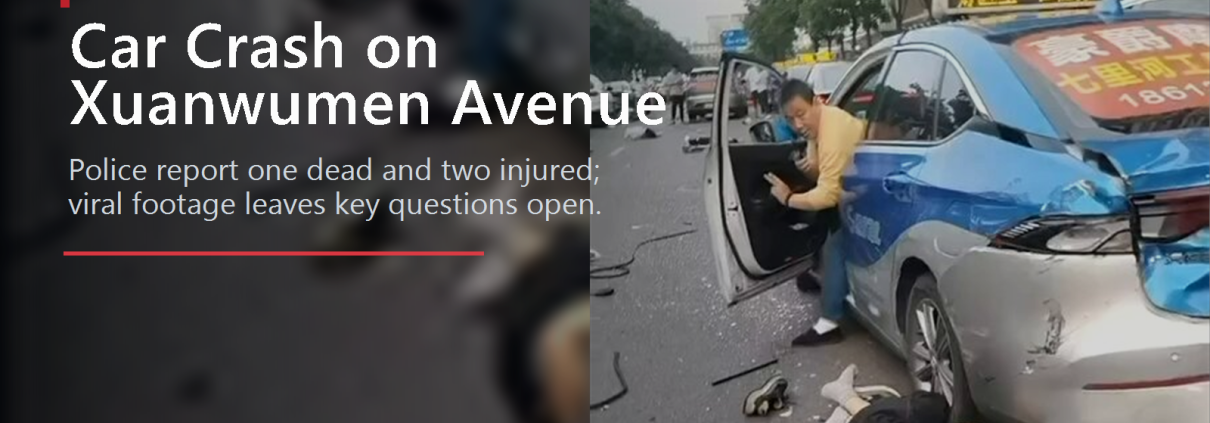
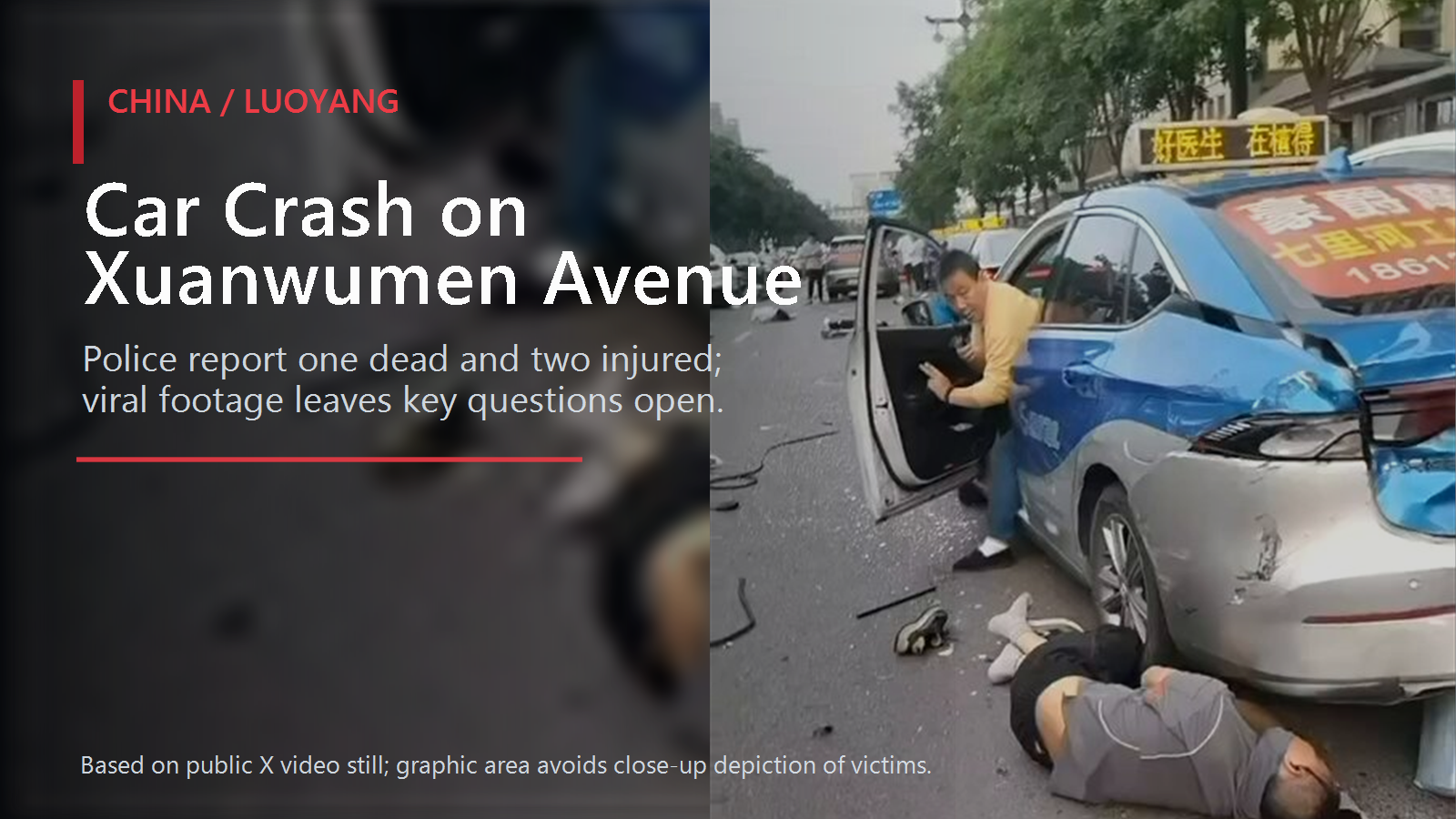
Realistic news cover for the Luoyang Xuanwumen Avenue car crash police report

Police in Luoyang, Henan province, say a 49-year-old driver was detained after a May 15 crash on Xuanwumen Avenue left one person dead and two others injured. Viral Chinese-language videos raised wider public concern, but the available official account describes the case as a traffic accident under investigation.

Realistic news cover for the Luoyang Xuanwumen Avenue car crash police report
News cover based on public reporting about the Luoyang crash.

Summary

A road incident in Luoyang, central China, drew attention after Chinese-language videos circulated on X/Twitter showing a vehicle striking people and vehicles on Xuanwumen Avenue. The post by the account “Teacher Li Is Not Your Teacher” described a car suddenly accelerating toward pedestrians. A police notice later said the driver, identified as Zhu Mouqiang, rear-ended an electric three-wheeler and an electric two-wheeler before losing control.

The most reliable confirmed information remains limited: one person died, two people were injured, four small cars were damaged, and the driver was controlled at the scene. Police said alcohol and drug-driving suspicions had been ruled out, while the cause and legal responsibility remain under investigation.

Confirmed Facts

  • The incident occurred at about 7 p.m. on May 15, 2026, in Xigong District, Luoyang, Henan province.
  • Luoyang traffic police said the vehicle was traveling along Xuanwumen Avenue before colliding with an electric three-wheeler and an electric two-wheeler, then losing control.
  • The official police notice reported one death, two injuries, and damage to four small cars.
  • The driver was identified by police as Zhu Mouqiang, male, 49.
  • Police said the driver was detained at the scene and that alcohol and drug-driving suspicions had been excluded.
  • The case remains under official investigation.

Source Verification

The initial public attention came from a Chinese-language X post that included video footage and described the vehicle as suddenly accelerating toward a crowd. That post is useful as a lead and as evidence of public concern, but it does not by itself establish motive, intent, or the full sequence of the crash.

The key confirmed details come from a police notice attributed to the Luoyang Public Security Bureau Traffic Police Detachment and republished by Chinese media outlets including CCTV, Sina, and Hainan Daily’s news site. New Tang Dynasty Television also reported on circulated videos and public discussion, but its framing goes beyond the official account and should be read separately from confirmed police information.

News cover showing the Luoyang Xuanwumen Avenue crash location and public safety concerns
Supporting news image for the Luoyang Xuanwumen Avenue crash report.

Background

Vehicle-ramming incidents and severe road crashes in Chinese cities have become especially sensitive topics online because some past cases involved deliberate attacks, while others were officially classified as ordinary traffic accidents. In this case, the available police statement does not confirm an intentional attack. It states that the car lost control after rear-end collisions and that the investigation is ongoing.

This distinction matters. The videos may appear alarming, and the public reaction is understandable, but a responsible account should separate what is visible in footage from what investigators have established.

Unverified Claims

  • The claim that the vehicle intentionally accelerated into pedestrians has not been confirmed by police.
  • The driver’s motive, if any, has not been verified.
  • The full number of people struck in the circulated videos cannot be independently confirmed from the available sources.
  • Any claim that this was a deliberate social-retaliation attack remains unverified unless authorities or reliable independent reporting provide evidence.

Potential Impact

The incident is likely to reinforce public anxiety around urban safety, traffic enforcement, and the reliability of official narratives after violent-looking public incidents. It also shows the role of Chinese-language social media outside China in surfacing local events that may otherwise receive limited national attention.

For readers outside China, the main point is not to treat either the viral footage or the official notice as complete on its own. The footage raises questions; the police statement provides the current official baseline; the unresolved issue is whether further investigation will clarify why the vehicle moved as it did.

Information Risk

  • Video-context risk: short clips can omit events immediately before or after the crash.
  • Official-narrative risk: Chinese police notices often provide limited detail in early stages and may not answer public questions about intent.
  • Attribution risk: naming the driver is based on the police notice; no independent court document is available yet.
  • Casualty-update risk: the death and injury count may change if authorities release later information.

Sources

Editorial note: This article is based on information available as of May 16, 2026. It will require updating if Luoyang police, hospitals, courts, or credible media release additional verified details.