KFC “Crazy Thursday” Reported Censored as China Marks June 4 Anniversary
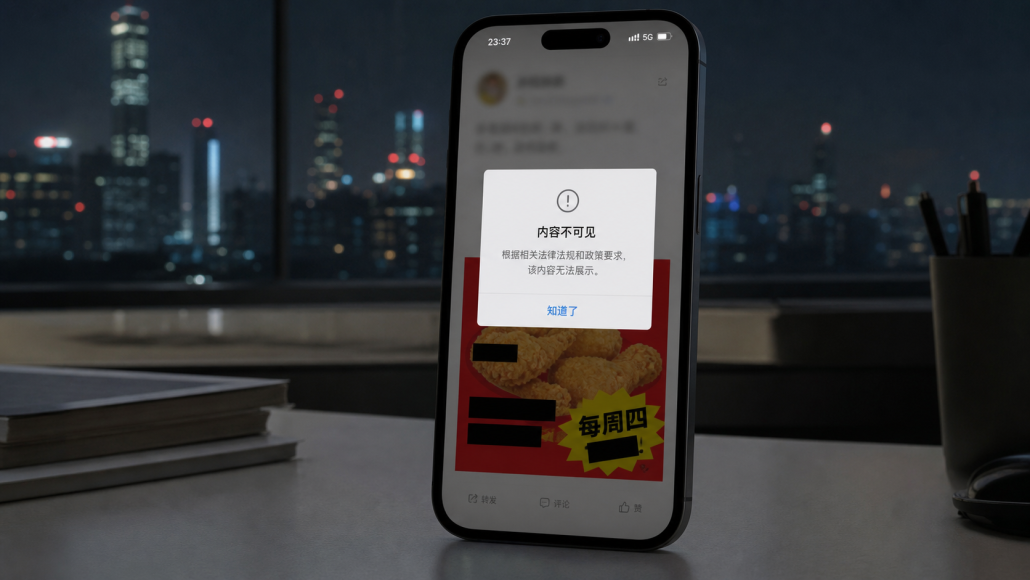
A viral report says Chinese social platforms restricted posts about KFC’s “Crazy Thursday” promotion as June 4, 2026 fell on a Thursday, turning a fast-food meme into another test of how China controls public memory of the 1989 Tiananmen crackdown.
Summary
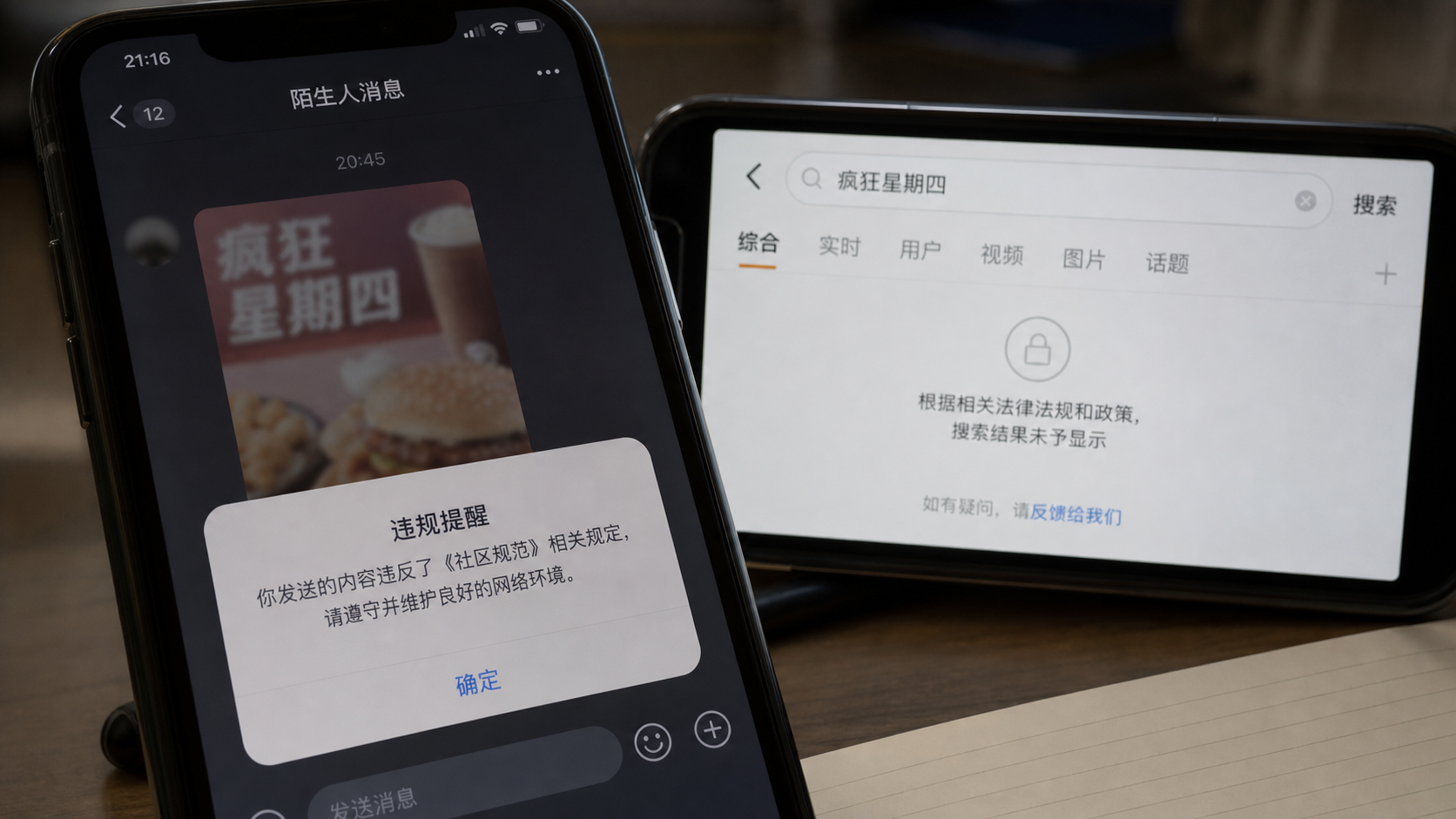
On June 4, the X account Teacher Li Is Not Your Teacher posted screenshots from a Chinese internet user who said a KFC “Crazy Thursday” promotional image sent through Douyin private messages was removed almost immediately for violating community rules. The post quoted an earlier June 3 report from the same account claiming that Weibo users had found “Crazy Thursday” listed as a banned phrase because this year’s anniversary of the June 4, 1989 Tiananmen crackdown fell on a Thursday.
The claim has not been confirmed by Weibo, Douyin, KFC China, or Chinese regulators. It should be read as a social media lead supported by screenshots and secondary reporting, not as a documented official order. But the claim fits a long, well-documented pattern: every year around June 4, Chinese platforms tighten controls on keywords, images, profile changes, memorial posts, and indirect references to the events of 1989.
Source verification
Teacher Li’s June 4 post said a user tried to send a “KFC Crazy Thursday” image to a friend on Douyin and saw it flagged within a second as violating community rules. The post included two images and quoted Teacher Li’s June 3 post, which said multiple users had found the phrase “Crazy Thursday” blocked on Weibo before the anniversary.
New Tang Dynasty Television also reported on June 3 that Weibo had set “Crazy Thursday” as a prohibited term because June 4 fell on a Thursday in 2026. Telegram mirrors and archive-style reposts preserved the wording of the June 3 claim after it spread across censorship-focused channels. None of those reports provides a platform statement, and none proves that every use of the phrase was blocked across all Chinese platforms. The careful conclusion is narrower: users and overseas Chinese-language media reported restrictions involving the phrase, and the timing points to June 4 sensitivity.
Primary confirmation remains limited. This article relies on the original X posts as leads, then checks the broader claim against long-running June 4 censorship patterns documented by AP, Amnesty International, and Freedom House. That supports the historical context well. It does not fully verify the exact moderation rule used by Weibo or Douyin in this specific case.
Why “Crazy Thursday” matters
KFC’s “Crazy Thursday” is not a political slogan. It is a mainland China fast-food promotion that became an internet meme. WARC says KFC launched the bundle in China in 2018, and that Weibo users turned it into a broader meme around 2021. Dao Insights describes the related “V me 50” joke as shorthand for asking someone to transfer 50 yuan through WeChat so the sender can buy discounted KFC food on Thursday.
That is why the reported restriction is revealing. The phrase does not mention Tiananmen, democracy, protest, students, tanks, or the Communist Party. Its political risk comes from the calendar. June 4, 2026 was a Thursday. A normal commercial phrase could be used as a joke, a coded reference, or a way to talk around censorship. In an environment where direct speech is heavily filtered, harmless words can become sensitive because users learn to speak indirectly.
The 1989 background
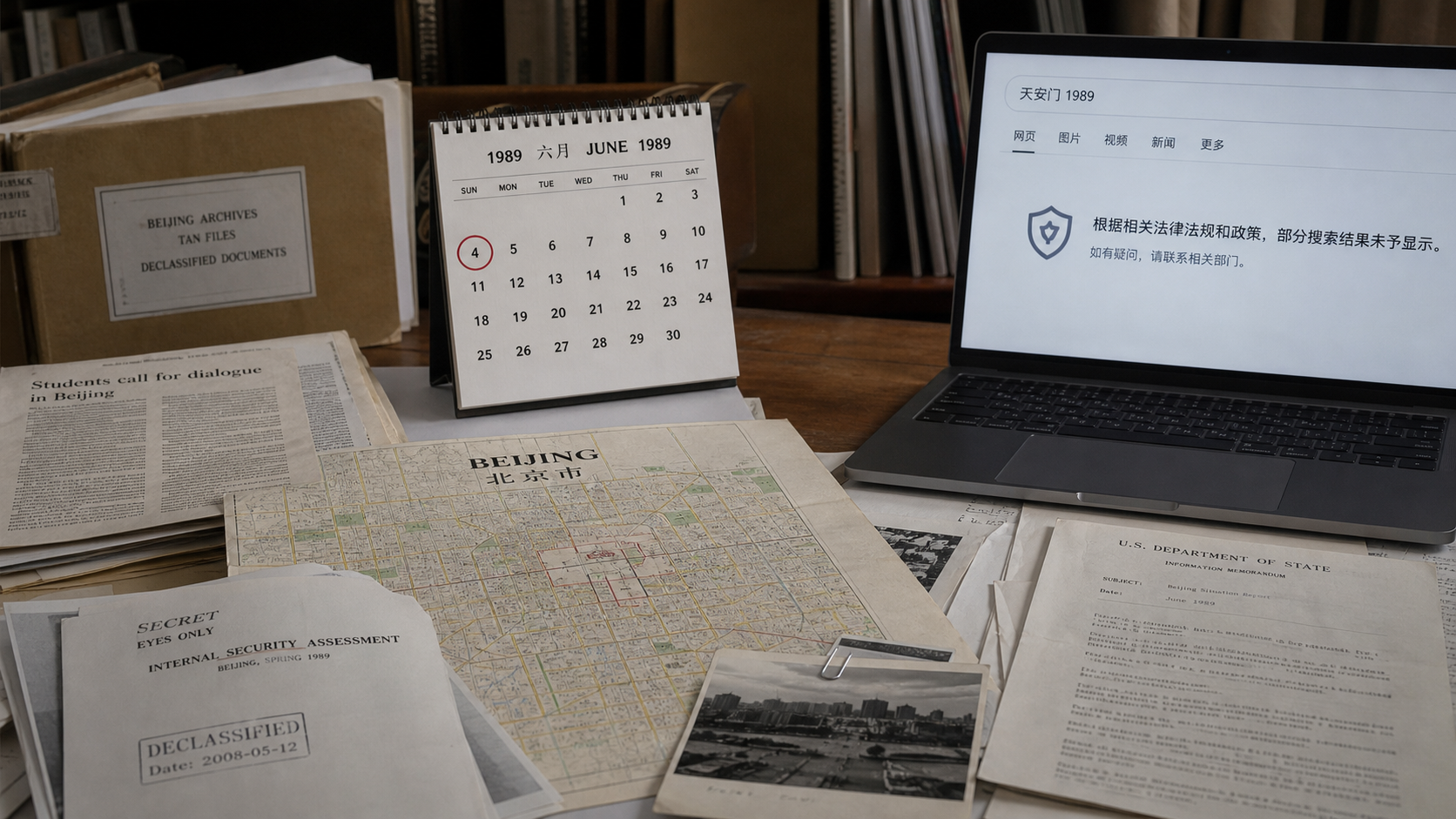
The Tiananmen protests began in April 1989 after students gathered in Beijing and called for political reform, action against corruption, press freedom, and broader civil rights. The movement drew support from workers, journalists, intellectuals, and residents in Beijing and other cities. On May 20, the Chinese government imposed martial law. On the night of June 3 and into June 4, troops and armored vehicles moved into central Beijing to clear the demonstrations.
The death toll remains disputed because the Chinese government has never allowed an open public accounting. Amnesty International notes that Chinese authorities claimed in late June 1989 that more than 200 people, including 36 college students, died during what officials called a riot, while human rights groups and outside reporting have long said the true number was likely higher. AP reported on June 4, 2026 that hundreds, and possibly thousands, were killed as troops advanced through crowds trying to stop the military from reaching Tiananmen Square.
The Chinese state has never accepted legal responsibility for the crackdown. Public commemoration inside mainland China remains banned. Families of victims, including members of the Tiananmen Mothers group, have faced surveillance, intimidation, and restrictions on mourning. AP reported today that police told relatives they would not be allowed to visit a Beijing cemetery on the 37th anniversary.
Censorship pattern
The reported “Crazy Thursday” block is not an isolated idea. Freedom House documented in 2019 that China uses yearly June censorship campaigns to stop discussion, commemoration, or basic learning about the 1989 protests. Its report said Weibo and WeChat had used more advanced tools and penalties around June 4, including blocks on direct and indirect references. Amnesty International says public mention of the crackdown, online or offline, remains banned in mainland China.
This system often reaches beyond obvious political speech. A date, number, emoji, song lyric, candle image, profile photo change, or platform “maintenance” notice can become part of the control environment. That is the context for the KFC claim. If “Crazy Thursday” was restricted, the target was probably not the promotion itself. The target was the possibility that ordinary users could turn a mass-market meme into a shared reminder of June 4.
Confirmed versus unverified
Confirmed: June 4, 2026 was the 37th anniversary of the 1989 Tiananmen crackdown and fell on a Thursday. KFC’s “Crazy Thursday” is a real China marketing campaign and meme. Teacher Li posted screenshots alleging restrictions on June 3 and June 4. New Tang Dynasty reported the same general claim. Amnesty, AP, and Freedom House document long-running censorship around June 4.
Unverified: There is no public platform notice confirming that Weibo or Douyin officially banned every use of “Crazy Thursday.” The screenshots do not prove the exact moderation rule, whether the block was keyword-based, image-based, account-specific, or temporary. They also do not prove whether KFC China was involved. The available record supports a story about reported platform censorship around a sensitive date, not a claim that a formal state order has been published.
Why global readers should pay attention
This matters because censorship can make even non-political language unstable. When a government tries to remove a historical event from public memory, the control system has to chase substitutes. Users avoid direct words, so platforms watch indirect words. Users move to jokes, so jokes become suspicious. Users send images, so images are scanned too.
That is how an anniversary becomes visible through what people are not allowed to say. The stronger the taboo, the wider the censorship net becomes. A commercial meme reportedly tripping moderation on June 4 shows how far the memory of 1989 still reaches inside China’s information system, even when the words “Tiananmen” and “June 4” never appear.
Information risk
Information risk is medium to high. The historical facts of the 1989 crackdown and the long-running censorship pattern are well supported. The specific 2026 “Crazy Thursday” restriction is less secure because it depends on user screenshots, social media posts, and overseas Chinese-language reporting. Chinese platforms rarely publish transparent moderation rules for politically sensitive terms, so outside verification is difficult.
The safest wording is therefore precise: Chinese users and overseas media reported that “Crazy Thursday” was restricted around June 4, 2026. The reported restriction, if accurate, fits China’s established June 4 censorship pattern. It should not be overstated as a confirmed nationwide ban without stronger evidence.
Sources
- Teacher Li Is Not Your Teacher, June 4, 2026 post: reported Douyin removal of a KFC “Crazy Thursday” image
- Teacher Li Is Not Your Teacher, June 3, 2026 post: reported Weibo restriction on “Crazy Thursday”
- AP, June 4, 2026: Chinese authorities erase Tiananmen crackdown from public memory
- Amnesty International: The 1989 Tiananmen Crackdown
- Freedom House: China’s Long, Hot Summer of Censorship
- New Tang Dynasty Television, June 3, 2026: Chinese-language report on “Crazy Thursday” as a restricted term
- WARC: KFC: Get Crazy for Crazy Thursdays
- Dao Insights: KFC harnesses power of memes with V50 nuggets


Leave a Reply
Want to join the discussion?Feel free to contribute!