Hong Kong Police Take Away Seven People Marking Tiananmen Anniversary With Flowers
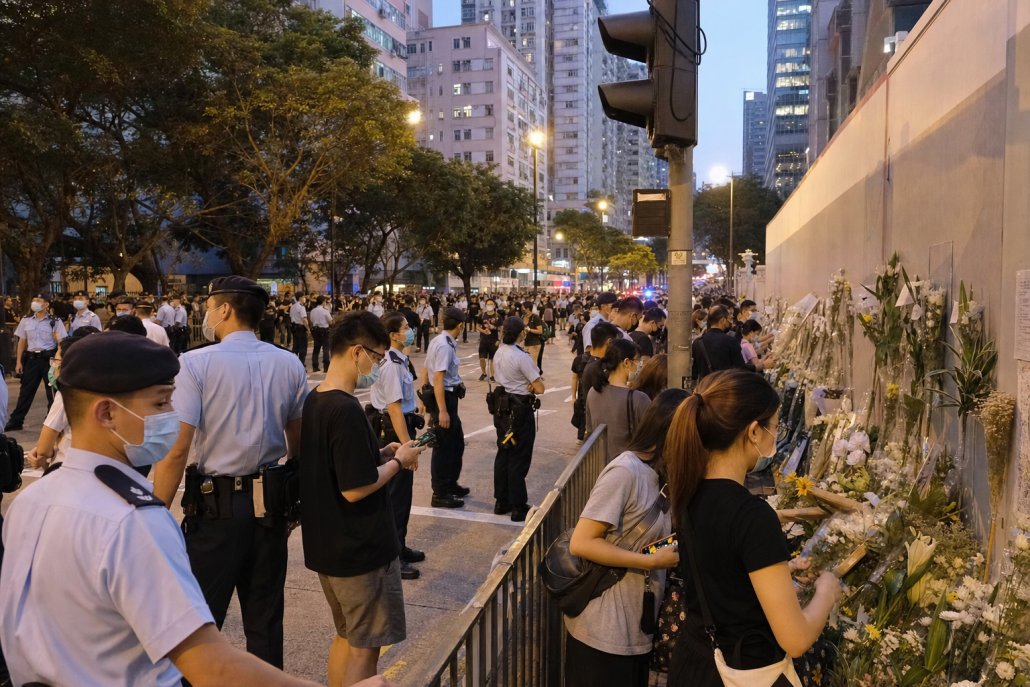
Hong Kong police took away seven people, including activist Chan Po-ying, in Causeway Bay on June 4, 2026, near the park that for decades hosted the city’s annual Tiananmen vigil. The removals did not involve immediate public charges, but they showed how even small symbolic acts, such as carrying flowers or wearing black, now draw police intervention in one of the last Chinese-speaking cities that once marked the June 4 anniversary in public.
Summary
The article is based on a recent post from Teacher Li’s X account about Chan Po-ying walking with a yellow paper flower in Hong Kong on June 4. That post was not treated as sufficient evidence on its own. The core facts were checked against English-language reporting from the South China Morning Post, Associated Press coverage from Hong Kong on June 3 and June 4, and Reuters photo captions documenting Chan with a flower and her later detention near Victoria Park.
The result is narrower than many viral claims on social media. What can be confirmed is that Hong Kong police removed seven people from Causeway Bay on the 37th anniversary of the 1989 Tiananmen crackdown, that Chan Po-ying was among them, and that the city maintained a heavy security presence around the former vigil site.
Confirmed facts
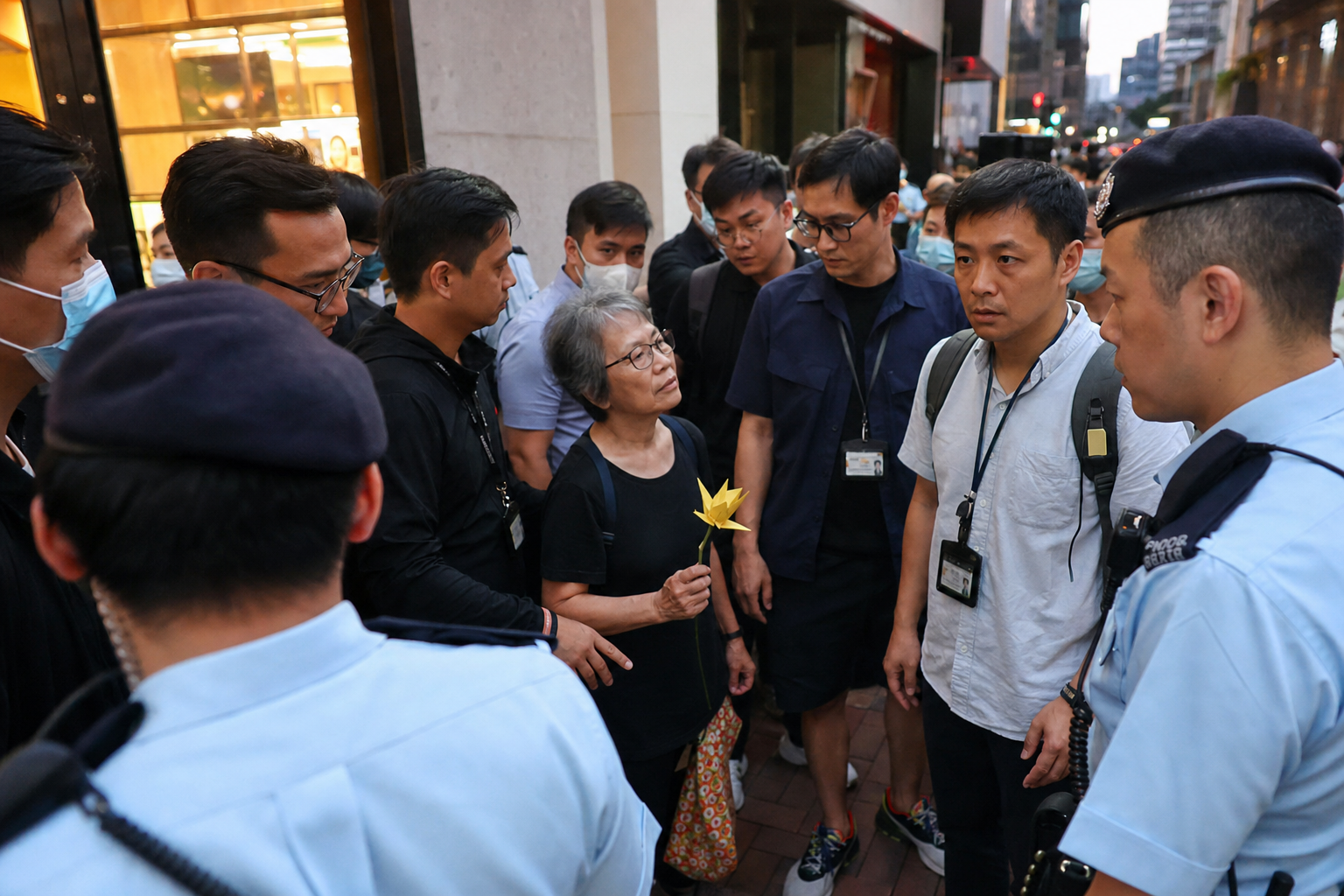
South China Morning Post reported on June 5, 2026 that Hong Kong police took away seven people in Causeway Bay on Thursday evening, including former League of Social Democrats chair Chan Po-ying and activist Virginia Fung King-man. The paper said police stopped and searched five men and two women, aged 17 to 79, for allegedly disrupting order near Great George Street and East Point Road. According to the report, they were removed for further investigation and later allowed to leave.
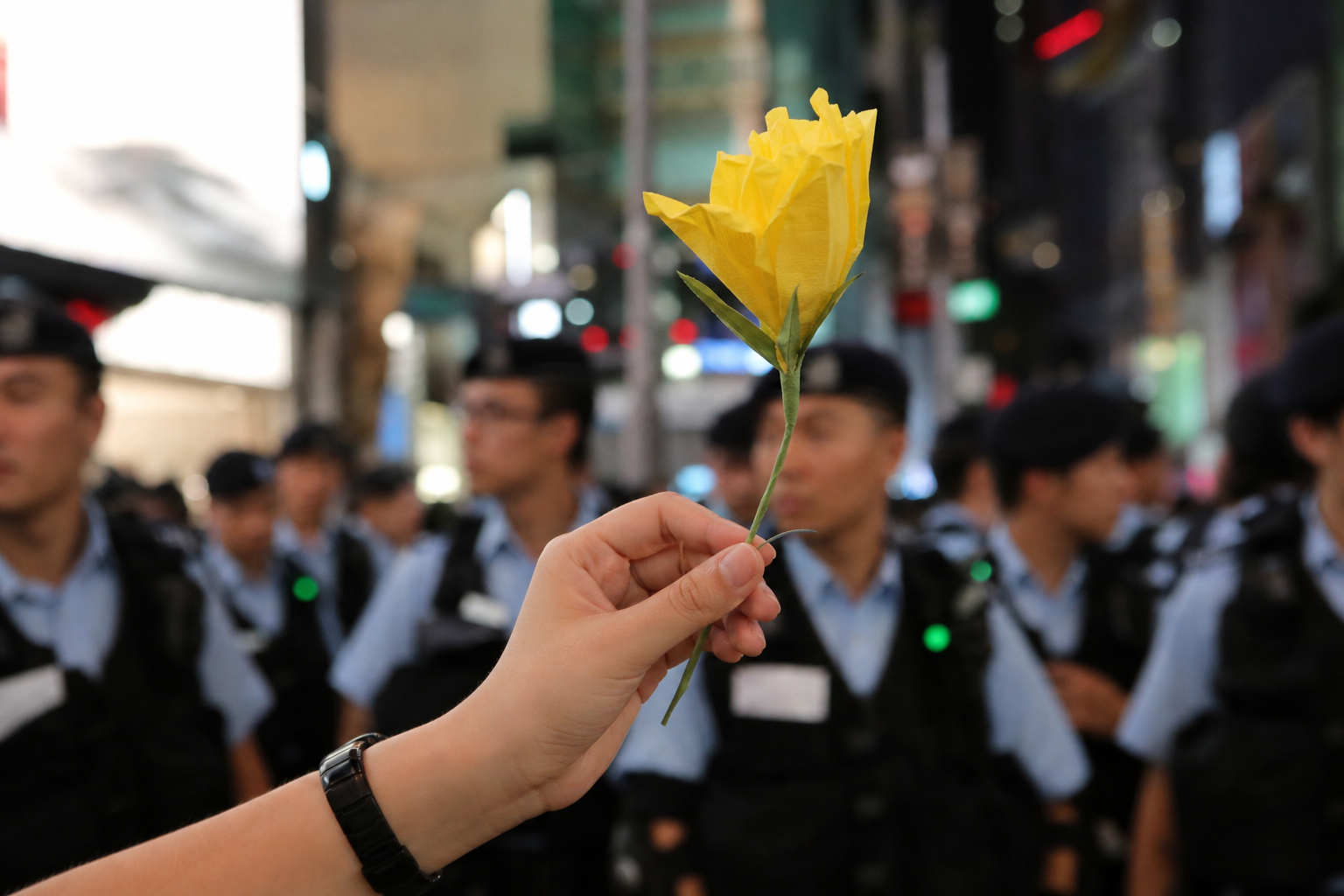
Reuters photo captions from June 4 place Chan Po-ying near Victoria Park holding an artificial flower and later being detained by police. Those captions do not by themselves establish the full legal basis for police action, but they do independently confirm the scene described in Teacher Li’s post: Chan appeared with a symbolic flower in the former vigil district and was then taken away.
Associated Press reported from Hong Kong on June 3 that police had already stopped performance artist Sanmu Chen on the eve of the anniversary after he tried to display a 6.4-meter red thread in Causeway Bay, an apparent reference to June 4. AP also noted that public commemoration in Hong Kong has become increasingly sensitive since the annual vigil was banned in 2020 and after Beijing imposed the national security law in 2020.
Taken together, these sources support a clear factual line. Hong Kong authorities deployed heavily around Victoria Park, police intervened against symbolic June 4 acts, and at least seven people were taken away on the anniversary itself.
Source verification
Teacher Li’s recent post about Chan Po-ying carrying a yellow paper flower matched the timing, location, and subject later described in mainstream reporting. That makes it a useful lead, but not a standalone source.
The strongest verification points are:
- SCMP’s report that seven people were taken away in Causeway Bay, with Chan named among them.
- Reuters photo captions showing Chan holding a flower near Victoria Park and then being detained.
- AP’s on-the-ground reporting on police intervention against June 4 memorial gestures in the same district one day earlier.
- It is not yet possible to independently verify the full content of every police warning delivered on scene.
- It is not yet possible to confirm that every removal on June 4 was triggered solely by flowers, clothing color, or other symbolic expression, as opposed to the police allegation of disrupting order.
- It is not possible, from the sources reviewed here, to prove that authorities issued a blanket written ban on every form of individual remembrance in Causeway Bay on June 4 itself.
- Reuters material available in open search was photo-caption based, not a full text dispatch.
- Police allegations of “disrupting order” are public, but the detailed case records for each removal were not available in the sources reviewed.
- Some of the most viral Teacher Li posts from the same day involved platform censorship anecdotes that may be true but could not be independently confirmed to the same standard.
- [Teacher Li post lead via Sotwe mirror](https://www.sotwe.com/whyyoutouzhele)
- [South China Morning Post: 7 taken away as police ramp up patrols around former site of Tiananmen vigil](https://www.scmp.com/news/hong-kong/politics/article/3356009/7-taken-away-police-ramp-patrols-around-former-site-tiananmen-vigil)
- [Associated Press: A Hong Kong artist trying to mark the Tiananmen crackdown is quickly stopped by police](https://apnews.com/article/hong-kong-tiananmen-crackdown-artist-sanmu-chen-4bdc7c34b4e9914bbccbb5a31d239870)
- [Associated Press: Hong Kong court hears final arguments in trial of Tiananmen vigil organizers, hopes for July verdict](https://apnews.com/article/hong-kong-tiananmen-trial-closing-arguments-7984e25ec34a9f4a11a97cb7b6b0411f)
- [Reuters Connect caption: Chan Po Ying holds an artificial flower near Victoria Park on June 4, 2026](https://www.reutersconnect.com/item/37th-anniversary-of-crackdown-on-pro-democracy-demonstrators-at-beijings-tiananmen-square-in-hong-kong/dGFnOnJldXRlcnMuY29tLDIwMjY6bmV3c21sX1JDMllNTEExRDNWOQ)
- [Hong Kong government: CE signs Safeguarding National Security Ordinance](https://www.info.gov.hk/gia/general/202403/22/P2024032200642p.htm)
- [Hong Kong Centre for Human Rights statement on June 4, 2026 police actions](https://hkchr.org/en/archives/4277)
Several other recent Teacher Li posts from the same period showed higher visible engagement on mirrored public pages, especially posts about online censorship, voice chat penalties, and platform moderation tied to June 4. Those posts were not selected for publication because reliable outside verification was limited or incomplete at the time of review.
Background
For decades, Hong Kong hosted the largest public June 4 commemoration anywhere on Chinese soil. Tens of thousands gathered annually in Victoria Park to remember those killed when Chinese troops crushed the 1989 student-led protests in and around Beijing.
That changed after the 2020 crackdown on Hong Kong’s pro-democracy movement. Authorities first banned the vigil during the COVID-19 period. Public commemoration never returned. The Hong Kong Alliance, the group that had long organized the vigil, later disbanded. Its leaders were prosecuted under national security charges.
AP reported in May 2026 that two former Alliance leaders, Chow Hang-tung and Lee Cheuk-yan, had completed final arguments in their national security trial and were awaiting a verdict that could come in July. If convicted, they face up to 10 years in prison.
The legal environment also tightened further in 2024. On March 23, 2024, Hong Kong’s Safeguarding National Security Ordinance, commonly called Article 23 legislation, took effect. In the government’s own explanation, the law was presented as necessary to safeguard national security while still protecting rights and freedoms. Critics inside and outside Hong Kong argue that the combined effect of the Beijing-imposed national security law and the local Article 23 law has narrowed the space for public speech, media work, and symbolic protest.
Unverified claims
Some claims circulating online go beyond what the current reporting supports.
Those distinctions matter. Hong Kong’s June 4 enforcement pattern is visible. The precise legal reasoning used in each case is still only partly documented in public reporting.
Potential impact
The immediate impact is practical and psychological. People in Hong Kong can still attempt symbolic remembrance, but the cost of doing so has risen. A flower, a candle, a brief performance, or a silent gesture now carries an obvious risk of police stop, search, detention, or removal.
The broader impact is about memory control. Beijing has long blocked public discussion of June 4 on the mainland. Hong Kong used to be the main exception. When even low-profile memorial acts trigger intervention near Victoria Park, the message is not subtle: public remembrance may survive, but it must shrink into fragmented, individualized, and risky forms.
This also matters outside Hong Kong. The city’s annual vigil once functioned as one of the most visible Chinese-language reminders that the Tiananmen crackdown remained unresolved history. As that space closes, more of the memory work shifts overseas to diaspora communities, archives, and independent media.
Information risk
This story is well enough verified to publish, but there are still limits.
For that reason, this article stays focused on the Hong Kong detentions that multiple external sources documented.


Leave a Reply
Want to join the discussion?Feel free to contribute!